|
Search TheMiddleAges.net |
Longbow |
|||
|
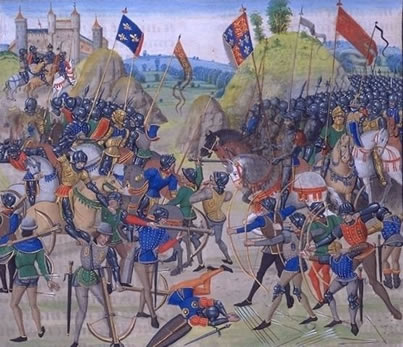
Longbows were difficult to master because the draw-weight often exceeded 50kg. Considerable practice was required to produce the swift and effective fire combat required. Skeletons of longbow archers are recognizably deformed, with enlarged left arms, and often bone spurs on left wrists, left shoulders and right fingers. The longbow decided a number of medieval battles fought by the English, the most significant of which being the Battle of Crecy and later the Battle of Agincourt during the Hundred Years' War. A variant (bow-staves) was used by 14th century mercenary troops of Sir John Hawkwood. Longbows were used until around the 16th century, when gunpowder began to be used, and such units as arquebusiers and grenadiers began appearing. Because a longbow is a long-range weapon, the bowmen were rather defenseless at close ranges (where units such as knights were more effective). So, they usually put physical barricades, such as stakes and poles driven in the ground, to attempt to mire the enemy forces (namely, cavalry and infantry), so they could systematically destroy them. Also, because they had an advantage over the slower-shooting, closer-ranged crossbowmen and traditional archers, they were generally the main core of the long-range infantry troops of any military force that used them. The main formation used was generally this:
To penetrate light armor, war arrows had "chisel" (or bodkin) heads, not hunting broad-heads. In peace-time, in some regions, carrying chisel points was a hanging offense, because it was thought to threaten noblemen, or they were taken as evidence that one was a highwayman. The importance of the longbow in medieval English culture can be seen in the legends of Robin Hood and in the "Song of the Bow," a poem from The White Company by Sir Arthur Conan Doyle.
|
Related Links: The Black Plague |
||
 Return to The Middle Ages Return to The Middle Ages |
This article is licensed under the GNU Free
Documentation License. You must provide a link to www.gnu.org/copyleft/fdl.html. To view or edit this article at
Wikipedia, follow this link. |